
Webflow Review: Is It Worth It for Businesses?
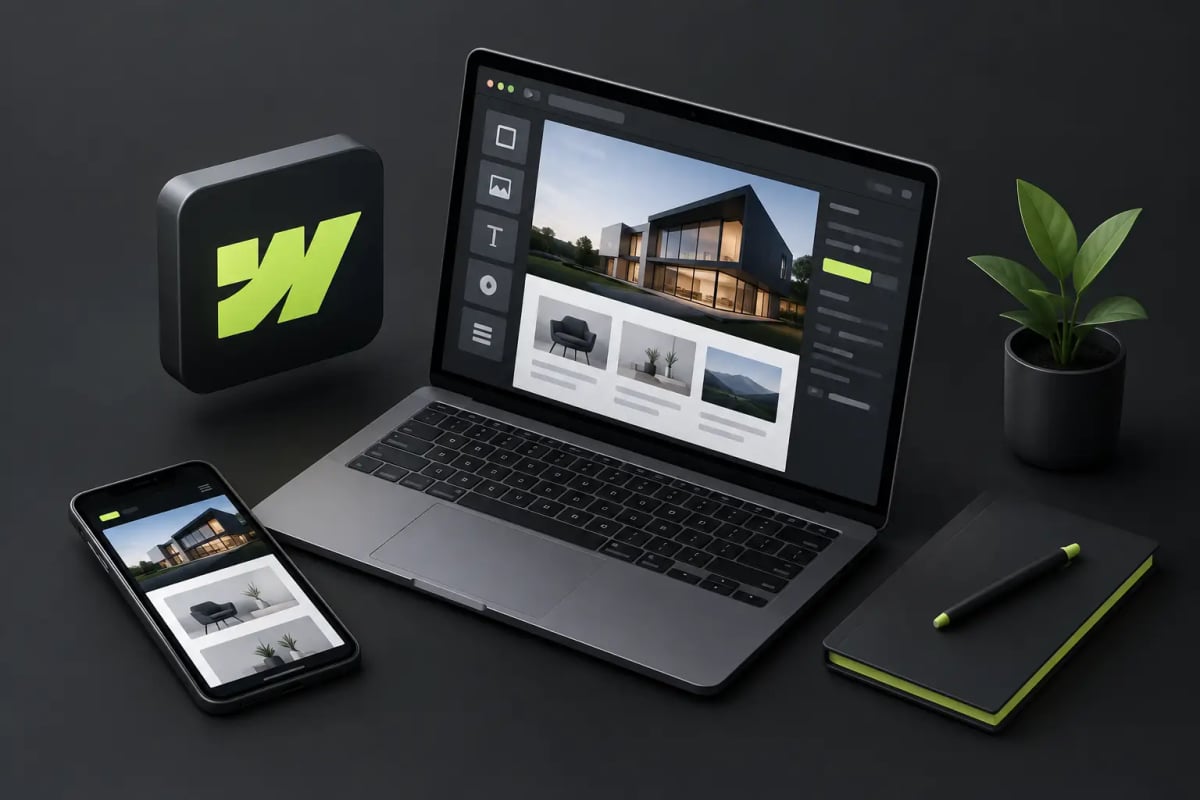
A slow website, difficult to edit, or built on a generic template can cost a business opportunities. This Webflow review takes a practical look at the platform: what it does really well, where it requires more judgment, and for what type of business it represents a smart investment.
Webflow is not just another page builder. It is a visual platform that allows you to design and develop custom sites without relying on a traditional coding process for every adjustment. Its great promise is clear: creative freedom with a technical foundation designed for publishing, scaling content, and maintaining performance.
For a brand that needs to generate leads, bookings, or digital authority, that difference matters. But not all businesses need Webflow, nor should all sites be built the same way.
Webflow Review: Why It Stands Out Against Other Web Builders
Most web builders prioritize immediate ease of use. This helps to launch a page quickly, but often imposes visual limits, repeated structures, and reduced control over how the site behaves on different devices. Webflow operates in a different realm: it provides a visual canvas much closer to professional design and development work.
This allows for building interfaces with identity. Spacing, typography, hierarchies, button states, color systems, grids, and animations can respond to a brand instead of trying to adapt the brand to a template. For businesses in architecture, technology, hospitality, finance, or premium services, this capability is a commercial advantage, not just aesthetic.
The platform also fosters better communication between design and development. A team that knows Webflow can move from UX/UI strategy to a functional page without losing details along the way. Fewer interpretations, fewer layers of approval, and a more agile delivery.
However, Webflow does not convert on its own. A visually stunning website, but lacking a clear value proposition, logical navigation structure, or well-placed calls to action, will remain just a pretty showcase. The tool enhances a good strategy; it does not replace it.
Custom Design Without Losing Speed
One of the biggest attractions of Webflow is that it allows for creating custom sites without dragging the weight of unnecessarily complex traditional developments. This benefits companies that need to move quickly, especially when the launch depends on a campaign, a new line of business, or a brand repositioning.
A well-planned project can be ready in weeks, not months. However, speed comes from having clear objectives from the start: what pages the site needs, what content exists, who approves, and what action the user should take. Trying to resolve strategy, branding, and site architecture at the end of the process always hinders delivery, regardless of the platform.
Webflow also excels in the quality of its interactions. It’s not about filling the page with effects. A useful animation can direct attention to a form, explain a complex service, or make an interface feel more polished. When movement is overused, the opposite happens: the site distracts, weighs more, and loses clarity.
The criterion here is simple: every visual element must help to understand, trust, or advance. If it does not fulfill one of those functions, it is unnecessary.
CMS: Real Control for Marketing Teams
The Webflow CMS is one of its most valuable features for companies that publish content consistently. Instead of manually creating each article, project, case study, job vacancy, property, or service page, an editable structure is created. The team then fills in defined fields, and Webflow generates the pages while respecting the design.
This is especially useful for an SEO blog, an architecture portfolio, a service catalog, or a news section. The marketing team can update titles, images, texts, authors, and categories without touching the visual structure of the site. This maintains consistency and reduces dependence on small technical changes.
The condition is to design the CMS with a forward-thinking vision. If a company plans to publish case studies with industry, results, testimonials, and related services, those fields must be considered from the initial architecture. An improvised CMS works at first, but becomes cumbersome as the volume of content grows.
It’s also important to be honest about its limitations. Webflow works very well for editorial content and structured dynamic pages, but an operation with complex rules, very specific permissions, internal calculations, or SaaS-like product logic will likely require additional development or a different architecture.
SEO in Webflow: A Good Foundation, Not a Set-and-Forget
Webflow offers solid tools for working on technical SEO: editing titles and descriptions, clean URLs, header tags, redirects, sitemap, robots.txt, and dynamic fields for CMS content. Additionally, it allows for precise care of a page's semantic structure, something many templates neglect.
This technical foundation helps search engines understand the site. It also better prepares the information for new AI-assisted search environments, where thematic clarity, authority, and useful answers are increasingly valuable.
However, publishing a site on Webflow does not guarantee a top spot on Google. Ranking depends on search intent, competition, content, internal linking, brand reputation, user experience, and information quality. A service page must address real questions, explain the process, demonstrate expertise, and facilitate the next step.
Speed also influences, although it’s wise to avoid simplistic promises. Webflow provides an efficient publishing infrastructure, but the final performance depends on how the site is built. Huge images, autoplay videos, third-party scripts, and uncontrolled animations can affect metrics. The platform provides a good foundation; the professional work lies in not wasting it.
Security, Hosting, and Maintenance
For many businesses, one of the less visible benefits of Webflow is the reduction of operational tasks. Hosting, SSL certificates, publishing, and various infrastructure updates are integrated within the platform. This decreases the need to install plugins, check for incompatibilities, or resolve frequent maintenance issues.
This model offers peace of mind, especially for teams without an internal technical department. It also reduces some common risks of sites built with ecosystems loaded with third-party extensions.
In exchange, one accepts to work within a controlled environment. In Webflow, there is less freedom to install any imaginable add-on. For a corporate website, a demand generation site, or an editorial portfolio, this is usually positive: fewer loose pieces, more order. For projects that depend on very specific integrations, it’s advisable to review the requirements before deciding.
Costs: The Question You Should Ask Before Building
Webflow has subscription costs that vary based on the type of site, CMS needs, e-commerce, languages, and traffic level. For a small business, looking only at the monthly fee may seem sufficient. For a growing company, it’s essential to assess the total cost of ownership: design, strategy, content production, maintenance, integrations, and site evolution.
The cheapest option is not always the most cost-effective. An inexpensive page that does not communicate differentiation, does not load well, or does not allow content updates may force a project redo before its time. On the other hand, paying for an advanced solution without a lead generation or content strategy also makes no sense.
The right decision depends on the function the website will serve. If it is a central commercial asset, it is worth investing in a structure prepared to grow. If you only need a temporary page to validate an idea, perhaps a simpler approach will suffice.
Who Is Webflow Worth It For?
Webflow is a great option for companies that value premium design, content autonomy, rapid publishing, and a well-cared technical foundation. It works especially well for service brands, creative studios, professional firms, tech companies, hotels, organizations, and businesses that require a digital presence with personality.
It is also a powerful alternative when the brand wants to escape the repeated aesthetics of many templates. In competitive markets like San José, where a customer can compare several options in minutes, a clear and memorable web experience can sway the decision.
It is not the best choice if the project is a highly customized application, a store with complex operations, or a platform that requires very specific user logic. In those cases, Webflow can be part of the solution, but not necessarily the entire system.
A good website is not measured by the tool it uses, but by what it manages to move: more business conversations, better bookings, greater trust, and a brand that feels ready to compete. Webflow offers creative and technical superpowers to get there, as long as the strategy has the same ambition as the design.