
Traditional CMS vs. Headless: Which One is Better?
A slow, hard-to-update, or limited website can become a business roadblock, even if it has an attractive design. The choice between a traditional CMS versus headless defines much more than just how to publish articles: it affects team speed, user experience, technical SEO, maintenance costs, and the freedom to evolve.
For a company looking to generate leads, bookings, or brand credibility, the right question is not which technology sounds more advanced. It’s which architecture allows for quick launches, clear content management, and sustained high-performance digital experiences without creating unnecessary complexity.
Traditional CMS vs. Headless: The Real Difference
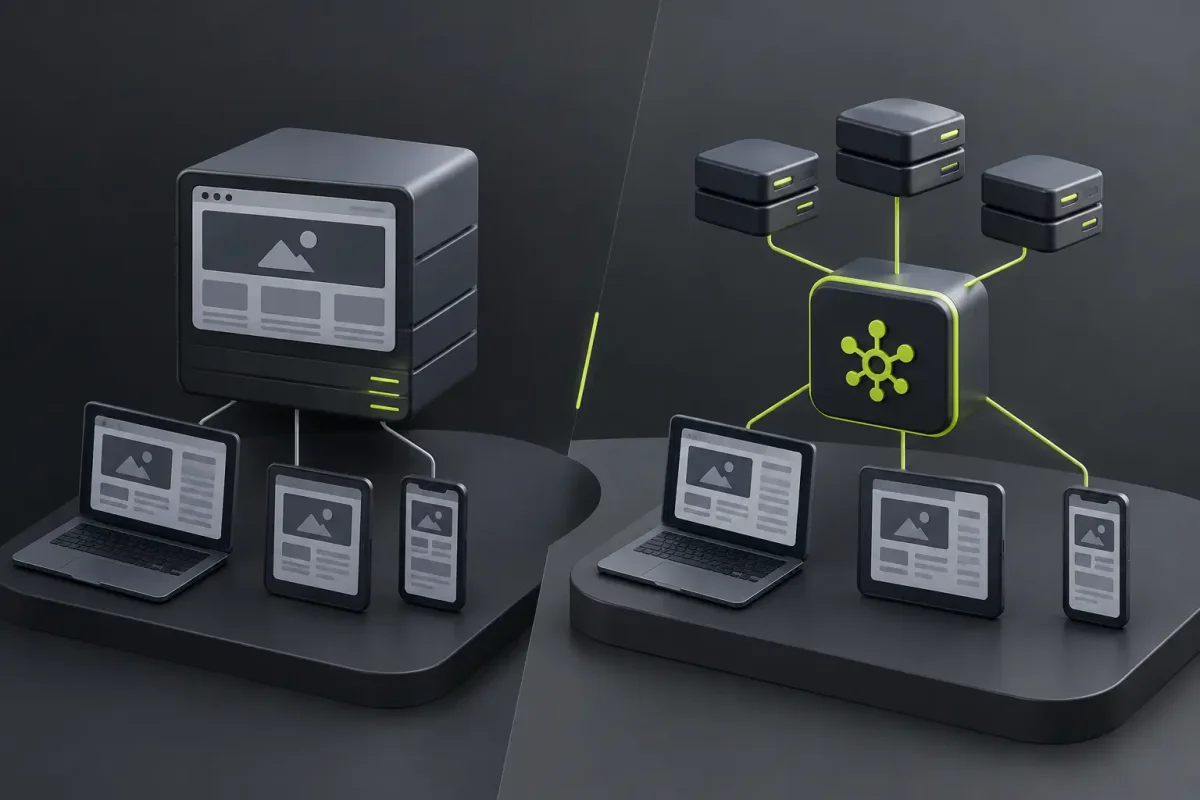
A traditional CMS combines the content panel, database, templates, and the visual layer of the site into one system. WordPress is the most well-known example. When a person publishes a page or a post, the CMS uses its theme and components to display it on the website.
A headless CMS separates content from presentation. The editorial team manages text, images, and data from a panel, but that content is delivered via an API to one or multiple channels: a website, an app, an in-store screen, a customer portal, or any other digital interface.
The difference may seem technical, but it has practical consequences. In a traditional system, editing and viewing content occurs within the same environment. In a headless architecture, content can be reused in different places, but a development layer is needed to build and maintain each visual experience.
Neither option wins by default. A well-configured traditional CMS can be very effective. A headless project can be extraordinarily flexible, but it may also be excessive for a corporate website that needs to go to market in a few weeks.
When a Traditional CMS Makes Sense
A traditional CMS usually works well when the priority is to operate a site with a clear structure and a simple editing process. It is a common choice for blogs, institutional sites, small catalogs, and projects where the website is the only relevant content channel.
Its main advantage is familiarity. Many companies already know WordPress or can easily find people who can edit it. There is also a huge ecosystem of extensions for forms, e-commerce, memberships, and other functions.
The challenge arises when that ease turns into a dependency on plugins, templates, and accumulated adjustments. Each extension adds a potential layer of maintenance, security, or slowness. This doesn’t mean that WordPress is a bad choice; it just requires technical criteria, constant updates, and an organized architecture to maintain a solid performance.
Advantages of a Modern Visual Platform
For many service brands, a visual platform like Webflow offers a very attractive middle ground. It allows content management without touching code, but with greater control over design, animations, components, and performance than the classic template-based approach.
Webflow integrates CMS, managed hosting, and design tools in an environment designed for marketing and business teams. This reduces friction when publishing a new service page, a case study, an article, or a job vacancy. It also prevents a simple update from turning into a chain of technical tickets.
Framer can be especially efficient for landing pages, portfolios, and brand sites that require speed of launch, elegant interaction, and direct editing. The choice between both platforms depends on the volume and complexity of the content, not on a technological trend.
When a Headless Architecture is Worth the Investment
Headless gains traction when a company needs to distribute the same content across multiple channels or build very specific digital experiences. For example, a company with a mobile app, a private portal, several regional brands, and a public site can benefit from managing content from a single source.
It can also be a wise decision if the product requires a complex interface, deep integrations with internal systems, or logic that doesn’t fit within the capabilities of a visual builder. In these cases, separating backend and frontend gives the development team the freedom to design each interaction precisely.
The cost of that freedom is that there are more pieces to coordinate. A team may need specialists in frontend, APIs, infrastructure, version control, and deployments. To change something visually simple, like a section of a commercial page, the marketing area could depend on development if a flexible editorial system wasn’t defined from the start.
Headless doesn’t guarantee speed on its own. A poorly built architecture can be slow, expensive, and difficult to maintain. Its potential emerges when there is a real need for multichannel scalability and a technical strategy capable of sustaining it.
The Criteria That Should Define Your Choice
Before comparing tools, it’s wise to look at the business. A website is a business asset, not a collection of technologies. Here are the questions that clarify the decision:
- Will the content only live on the website, or will it also feed an app, a portal, or multiple channels?
- Who will publish and update the content: marketing, sales, an administrator, or developers?
- How often will pages, campaigns, and commercial messages change?
- What level of visual customization, animation, and integration does the experience need?
- What is the actual budget for construction, maintenance, and technical support?
If the goal is to launch a premium, fast, and conversion-oriented presence, the ease of updating should weigh heavily. A campaign that takes weeks to publish loses momentum. A page that relies on multiple providers to adjust a headline, an offer, or a form also reduces the business's responsiveness.
SEO deserves separate analysis. Both a traditional CMS and a headless approach can rank well, but the outcome depends on execution: content structure, performance, tags, accessibility, internal linking, indexing, and page quality. The architecture does not replace a search strategy or content that responds better than the competition.
In headless projects, special attention must be paid to rendering, routes, metadata, and page generation so that search engines interpret the content correctly. In managed visual platforms, many technical bases are resolved, although it is still necessary to plan each page with SEO intent.
The Hidden Cost is Not Always in the Platform
Comparing monthly prices is useful but insufficient. An economical CMS can end up costing more if it requires frequent maintenance, security updates, conflict resolution between plugins, or support for each design change. On the other hand, a headless solution may have reasonable licenses and still require a high investment in specialized development.
The relevant question is how much it costs to operate the site over the next two or three years. This includes publishing campaigns, creating new sections, optimizing conversions, protecting the site, training the team, and adapting the platform when the business changes.
For companies in San José competing for digital attention with increasingly polished brands, execution speed is also a cost. Arriving late to a season, a promotion, or a business opportunity has a direct impact on sales and positioning.
A More Strategic Choice for Growth Sites
If your business needs a branded website with custom design, service pages, a blog, case studies, forms, and editorial control, a modern visual platform usually offers a very favorable relationship between performance, autonomy, and time to launch. There’s no need to adopt a headless architecture just because it exists.
If, on the other hand, the content needs to feed multiple digital products or the experience depends on complex systems, headless may be the right foundation. The key is to design the architecture around the actual operation, not around a technical label.
At Flow, the approach starts with that conversation: identifying what the site needs to achieve before choosing how to build it. A brand that needs to look premium also needs to load quickly, be easy to manage, and be ready to convert visits into opportunities.
The best platform is the one that allows you to publish with confidence, evolve without friction, and maintain an experience that propels your business forward, not one that waits for technology.