Webflow or traditional development: which is right for you
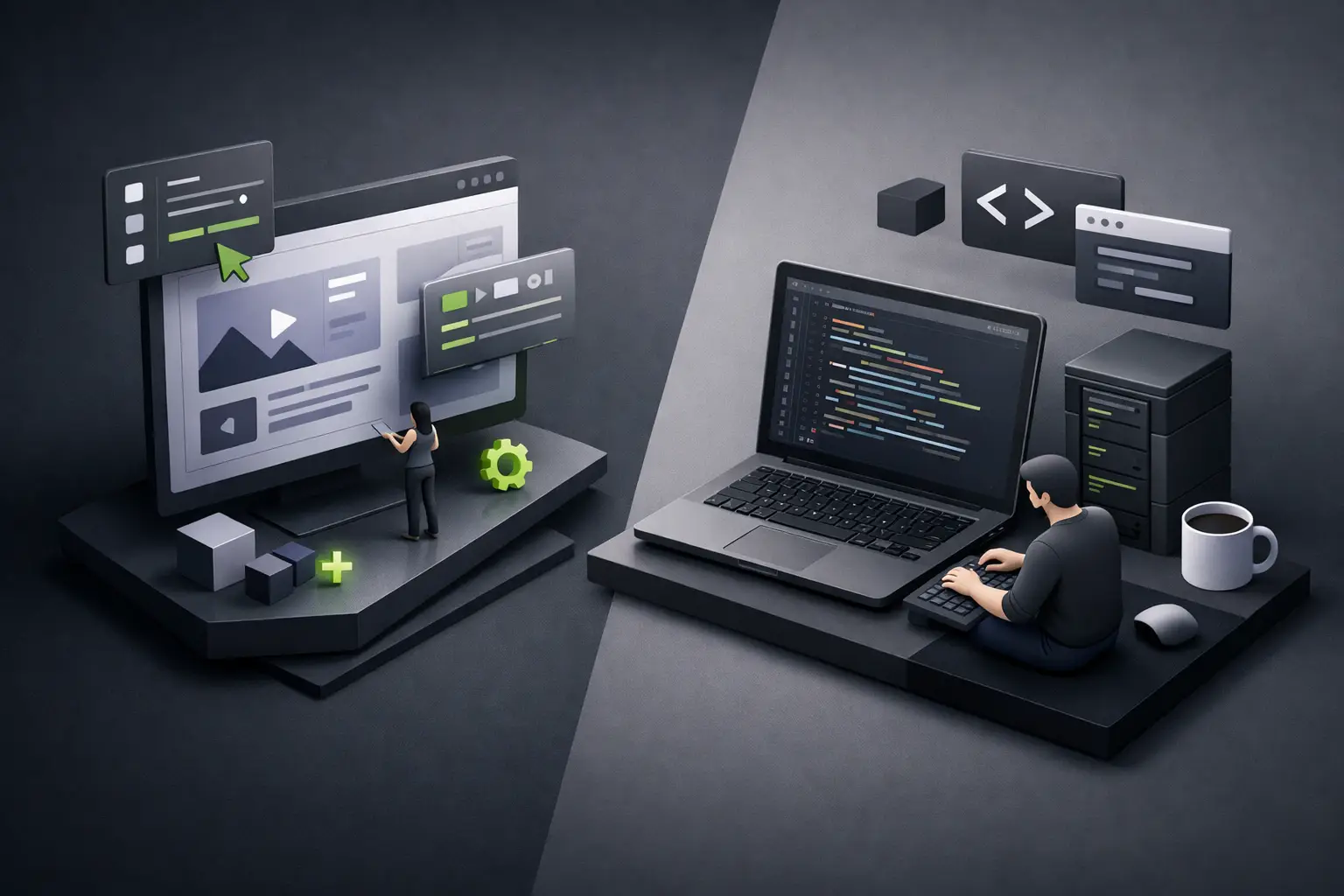
If you're evaluating Webflow or traditional development, you probably don't lack technical information. What's usually missing is clarity to make a business decision. Because this comparison isn't just about how a site is built, but about how long it takes to launch, how easy it will be to maintain, and how much real control your team will have after launch.
The right question isn't which option is "better" in the abstract. The useful question is which one delivers more results according to your goals, budget, execution speed, and the type of digital experience you need.
Webflow or traditional development: the real difference
In simple terms, Webflow is a visual platform that allows you to design and develop professional websites with great control over design, structure, CMS, animations, and performance, without relying on custom programming from scratch for each piece. Traditional development, on the other hand, involves building the site with custom code or more personalized frameworks and technologies.
That changes almost everything. It changes timelines, maintenance costs, vendor dependency, and even the way your company publishes content. It also changes the level of technical flexibility available when the project has very specific needs.
Webflow shines when a company wants a visually solid site, quick to launch, easy to edit, and well-prepared for SEO. Traditional development gains ground when there's complex logic, uncommon integrations, advanced private areas, or functionalities that simply fall outside the natural scope of a visual platform.
When Webflow has the advantage
If your goal is to launch a corporate page, service site, high-performance landing page, or portal with a well-structured CMS, Webflow usually offers an attractive combination of speed, control, and visual quality. We're not talking about rigid templates. We're talking about designing something custom with a more efficient technical foundation.
The first advantage is time. In projects where the market moves fast, waiting months for complete development can cost more than the investment itself. Webflow shortens that process and allows you to move from design to production with less friction. For a brand that needs to generate leads, sell a better image, or activate campaigns, that matters a lot.
The second advantage is autonomy. Many companies don't want to depend on a developer every time they need to change text, add a case study, or publish a new service. With a well-planned CMS, the team can move content without touching code and without breaking the design.
The third is the balance between design and performance. Webflow allows you to build premium visual experiences without sacrificing structure, speed, or technical order. That's key when you want a website that looks strong, loads fast, and also has a solid foundation for positioning.
Where traditional development is still the best route
There are cases where Webflow isn't the ideal answer, and saying otherwise would be misleading. If your project needs advanced authentication, complex dashboards, deep business logic, connections to very specific internal systems, or a web application more than a website, traditional development is still the right route.
It also applies when you need absolute control over every layer of the system. An internal technical team may prefer their own architecture, controlled repositories, customized deployments, and total freedom to scale complex functionalities. In that scenario, a visual platform can feel limiting.
Another important point is the technical longevity of the project. If your business is building a digital product that will evolve as software, not just as a web presence, it makes sense to think from the start about a more flexible development foundation for the long term.
Costs: not just how much you pay, but what you're buying
Many people compare Webflow or traditional development looking only at the initial budget, and that usually distorts the decision. The real cost of a website doesn't end on launch day.
With traditional development, the initial amount can vary greatly depending on complexity, team, and stack. But there are also adjustments, support, maintenance, small tickets, and dependency for changes that seem simple. A new button, an additional section, or a CMS modification can turn into a chain of reviews.
With Webflow, the cost tends to be more predictable on corporate and commercial sites. There's managed hosting, integrated security, and lighter operations for frequent changes. That doesn't mean it's always cheaper. It means that, for certain types of projects, it buys efficiency in addition to design.
The useful question here is this: do you want to invest in a platform that accelerates execution and reduces dependency, or do you need a custom solution because your business really demands it? If extreme customization doesn't generate return, it often just adds complexity.
SEO and performance: where the decision really impacts
From a commercial perspective, this point weighs more than the technical discussion. A site can look good and still perform poorly. If it doesn't load fast, doesn't have clean structure, or hinders optimizations, it ends up slowing visibility and conversions.
Webflow has a clear advantage for teams that value an orderly technical foundation for SEO. It allows you to work with titles, meta tags, URLs, semantic structure, redirects, well-organized CMS, and reasonable control over key elements without entering long development cycles. Plus, publishing speed helps when strategy depends on moving quickly.
Now, traditional development isn't at a disadvantage by nature. In fact, it can achieve excellent results. The point is that it depends much more on the quality of the team that builds it. If development focuses only on functionality and leaves SEO for later, fixing it afterward can be more expensive and slower.
When a company wants to compete in search engines and also look premium, the platform matters, but how the project is designed and structured from the start matters more.
Content control and daily operations
This is where many decisions become obvious. If your marketing team needs to publish testimonials, update services, edit text, or create new pages frequently, Webflow has a strong operational advantage. The site stops being a closed box and becomes an editable asset.
In traditional development, this depends entirely on how the back-end was built. It can be very well resolved or it can become a permanent headache. There are custom-made sites that end up being so unfriendly that the client prefers not to touch them. And that, in a competitive digital environment, slows you down.
For growing companies, the ability to iterate quickly isn't a luxury. It's a competitive advantage. Adjusting a services page, launching a new campaign, or testing a better value proposition without entering a technical queue can make a difference.
Premium design: no-code doesn't mean basic
There's still the idea that a visual platform limits design quality. That idea is outdated. Today you can build sites with a very high visual level, careful interactions, and a much stronger digital identity than many traditional developments done with a purely technical approach.
The difference lies in the judgment of the studio or team executing the project. A powerful tool in the right hands accelerates results. In mediocre hands, it doesn't matter if there's code or not.
That's why, when you compare Webflow or traditional development, you shouldn't just compare technologies. You should compare processes, design level, UX criteria, SEO approach, and ability to deliver a website that actually helps you sell.
So, which one is right?
If you need a corporate site, commercial or brand website with high visual level, quick launch, good performance, content control, and a structure ready to grow, Webflow is usually the smartest choice. Especially if you want to reach market without dragging months of development.
If what you're building looks more like a complex digital product than a website, if you depend on advanced functionalities, or if you require a completely customized architecture, traditional development makes more sense.
There's no universal answer, but there is a strategic answer for each business. In many cases, the strongest option isn't the most complex one, but the one that eliminates friction and gets you to results faster.
For brands that want to move quickly without looking generic, Webflow offers a mix hard to ignore: premium design, control, security, and execution speed. And when that site is also built with SEO vision and conversion focus, it stops being just a pretty page. It becomes a real commercial tool.
Before choosing, don't ask yourself which technology sounds more advanced. Ask yourself which one puts you in front of your customers faster, with a better image, less dependency, and more ability to grow. That's usually where the right answer appears.