Visual CMS or Traditional Development for Businesses
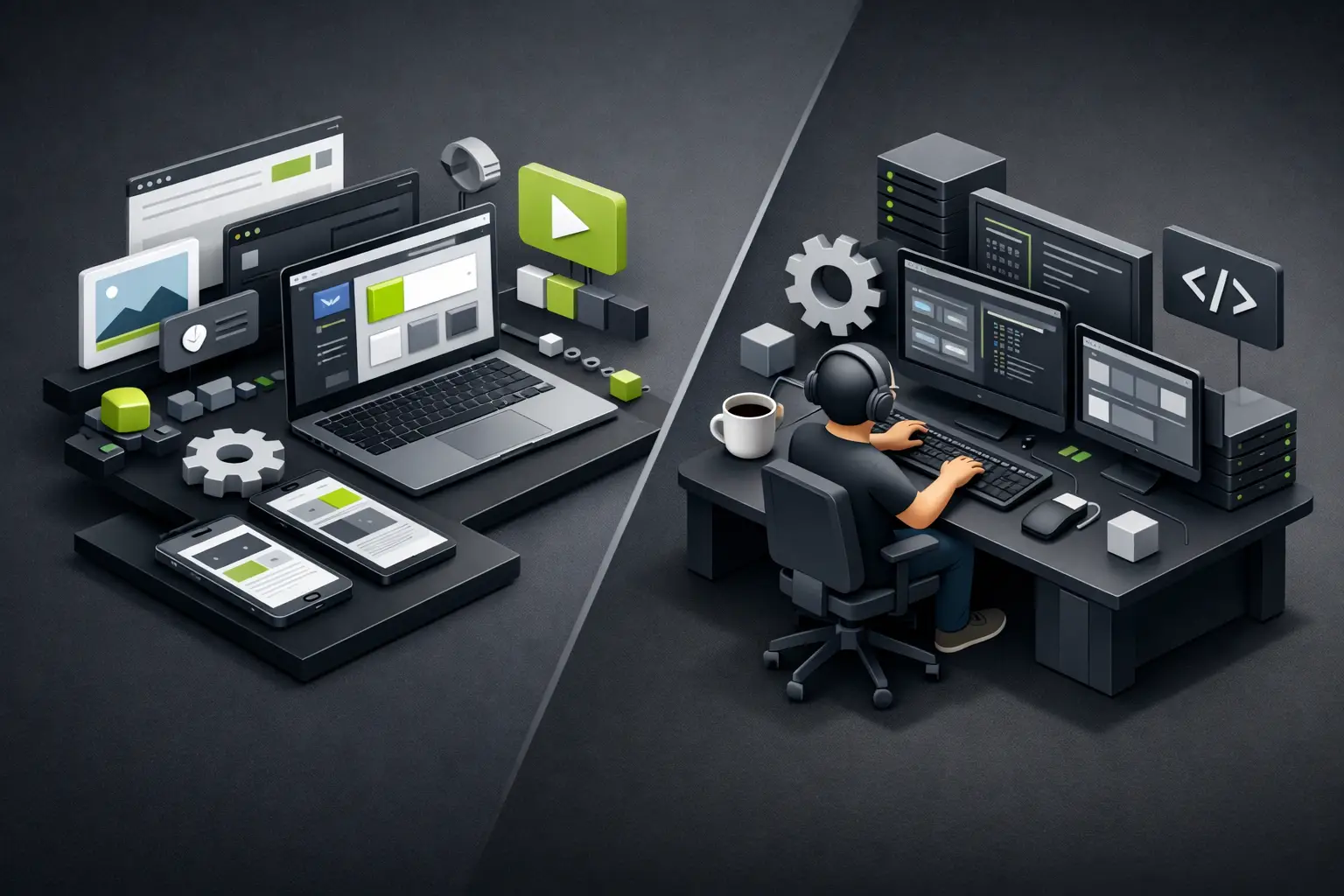
A website stuck for weeks waiting for a text adjustment, a new page, or a campaign is not a growth asset. It's a bottleneck. The decision between visual CMS or traditional development defines much more than how to build a website: it affects your launch speed, your team's control, the cost of evolution, and the ability to convert visits into opportunities.
For a company that needs to position itself, capture leads, or increase bookings, the right question is not which option is "better" in absolute terms. The question is which one allows you to launch with quality, operate with agility, and scale without paying for complexity you don't yet need.
The real change is not visual, it's operational
For years, developing a custom website meant depending on code for almost everything. Every section, form, design change, or content update went through a developer. That model is still valuable in complex projects, but it doesn't always match the commercial pace of a modern business.
A visual CMS like Webflow allows you to build personalized experiences with an interface that connects design, structure, and content. It's not about using a generic template or sacrificing brand identity for speed. When done well, it allows you to create a premium page with elegant animations, clear SEO architecture, and a content panel your team can use without touching code.
Framer moves with particular strength in launch sites, personal brands, portfolios, and commercial pages that need to go live quickly with flawless visual execution. Both change the conversation: the website stops being a static delivery and becomes a tool the business can move.
When a visual CMS generates more value
A visual CMS is a strategic decision when the company needs speed without lowering visual standards. It's ideal for corporate sites, campaign landing pages, service businesses, hospitality projects, creative studios, architecture firms, organizations and brands that publish case studies, articles, team, locations, or services frequently.
The biggest advantage is control. Once the structure is well-designed, a marketing person can update a news item, change a photo, publish a project, or adjust a call to action without opening a support ticket. That autonomy reduces downtime and makes the web support business decisions rather than arrive late.
There's also an important performance advantage. Platforms like Webflow and Framer include managed hosting, security certificates, fast publishing, and a clean technical foundation when the project is built with criteria. This allows you to concentrate investment on what the user actually perceives: experience, messaging, visual hierarchy, speed, and conversion.
But a visual CMS is not magic. A poorly planned website can still be slow, confusing, or difficult to manage even if it uses the best platform. The result depends on content strategy, the quality of UX/UI design, the structure of collections, image optimization, and technical decisions that happen before publishing.
More speed, but with direction
Launching earlier has value when there's a clear strategy. A company doesn't need to spend months developing basic features that a visual platform already solves. It can dedicate that time to validating its proposal, improving messaging, creating useful content, and optimizing the pages that attract customers.
For businesses in San José competing for attention in saturated markets, arriving first with a professional presence can make a difference. It's not enough to publish fast: you need to launch with an identity that looks your own, intuitive navigation, and pages prepared to guide the user toward a consultation, a booking, or a sale.
When traditional development is the best route
Traditional development gains strength when the website is not just a communication channel but the core of a complex digital operation. Think of a platform with particular business rules, multiple user roles, advanced calculations, deep integrations with internal systems, real-time inventory, or processes that don't exist natively in a visual CMS.
In those cases, creating a code-based solution can provide a superior level of flexibility. A technical team can define every detail of the logic, connect specific services, and build functionalities that respond to a very particular need. The problem appears when a company chooses this path for a website that really only needs service pages, a blog, portfolio, forms, and content management.
Custom code has costs that go beyond launch. You have to consider maintenance, updates, security, documentation, testing, and dependency on specialized personnel. If the original provider disappears or the project isn't well documented, a small modification can become an expensive and slow task.
That doesn't mean traditional development is a bad investment. It means it should be justified by the real complexity of your business, not by the idea that "built from scratch" always equals better.
Visual CMS or traditional development: compare what affects your business
The most useful comparison isn't resolved by technical preferences. It's resolved by looking at the impact on operations, marketing, and growth. Before deciding, it's worth reviewing four concrete factors:
- Time to launch: a visual CMS allows you to publish strategic sites in weeks. Traditional development usually requires more stages of definition, programming, and testing.
- Content autonomy: with a well-configured CMS, your team can keep the website updated. In a coded solution, this depends on how the admin was built.
- Functional complexity: if you require unique logic, very specific automation, or critical connections with internal software, traditional development may be necessary.
- Cost of evolution: don't compare just the initial budget. Evaluate how much it will cost to create new pages, improve conversions, add sections, and maintain the technology over the next few years.
The right platform is the one that reduces friction without limiting your next moves. For many companies, that means a personalized visual CMS. For others, it might mean combining a high-performance visual website with a custom app or system connected through integrations.
SEO, artificial intelligence, and structure: the detail you don't see
An attractive website that search engines don't understand well loses opportunities. Current SEO doesn't depend solely on repeating keywords. It requires clear structure, content that answers real questions, competitive load times, heading hierarchy, carefully managed metadata, and pages that demonstrate expertise.
Modern visual CMSs allow you to work on these elements with precision: organized URLs, titles, descriptions, dynamic content, alternative tags, and redirects. Plus, they make it easy to keep the site alive, which is key when search engines and AI-driven search experiences prioritize useful, contextualized, and well-organized responses.
Here's a necessary warning: no platform guarantees rankings. Webflow, Framer, or traditional development can perform well in SEO if implemented correctly. The difference is that a visual CMS makes it easier for your team to publish and optimize constantly, without turning every improvement into a technical project.
Don't confuse freedom with chaos
Giving access to content doesn't mean handing design over to chance. A professional CMS defines components, styles, fields, and rules so your team can update without breaking the visual experience. That's the difference between a site that's easy to edit and one that ends up full of inconsistent buttons, heavy images, and unstructured pages.
The best setup combines autonomy with brand protection. Your team controls content that changes; the design foundation maintains the quality that makes your company recognizable.
A decision that should start with objectives
If your priority is launching a personalized website quickly, managing content without dependency, and maintaining a premium image, a visual CMS is usually a very smart choice. If you need to create a platform with unique logic and complex processes, traditional development can give you the level of control you need.
The answer can also be hybrid. A brand can use Webflow or Framer for its public website, where speed, SEO, and conversion are priority, and connect specialized tools for bookings, CRM, payments, automations, or internal management. This way you avoid building from scratch what already works and concentrate custom development where it really creates advantage.
Before approving a budget, ask them to explain what your team will be able to edit, what will depend on a provider, how performance will be measured, and how long a simple business improvement will take. The best technology isn't the one that sounds most complex: it's the one that lets you move forward with more speed, confidence, and clarity when the market demands action.