
Custom Corporate Website vs Template
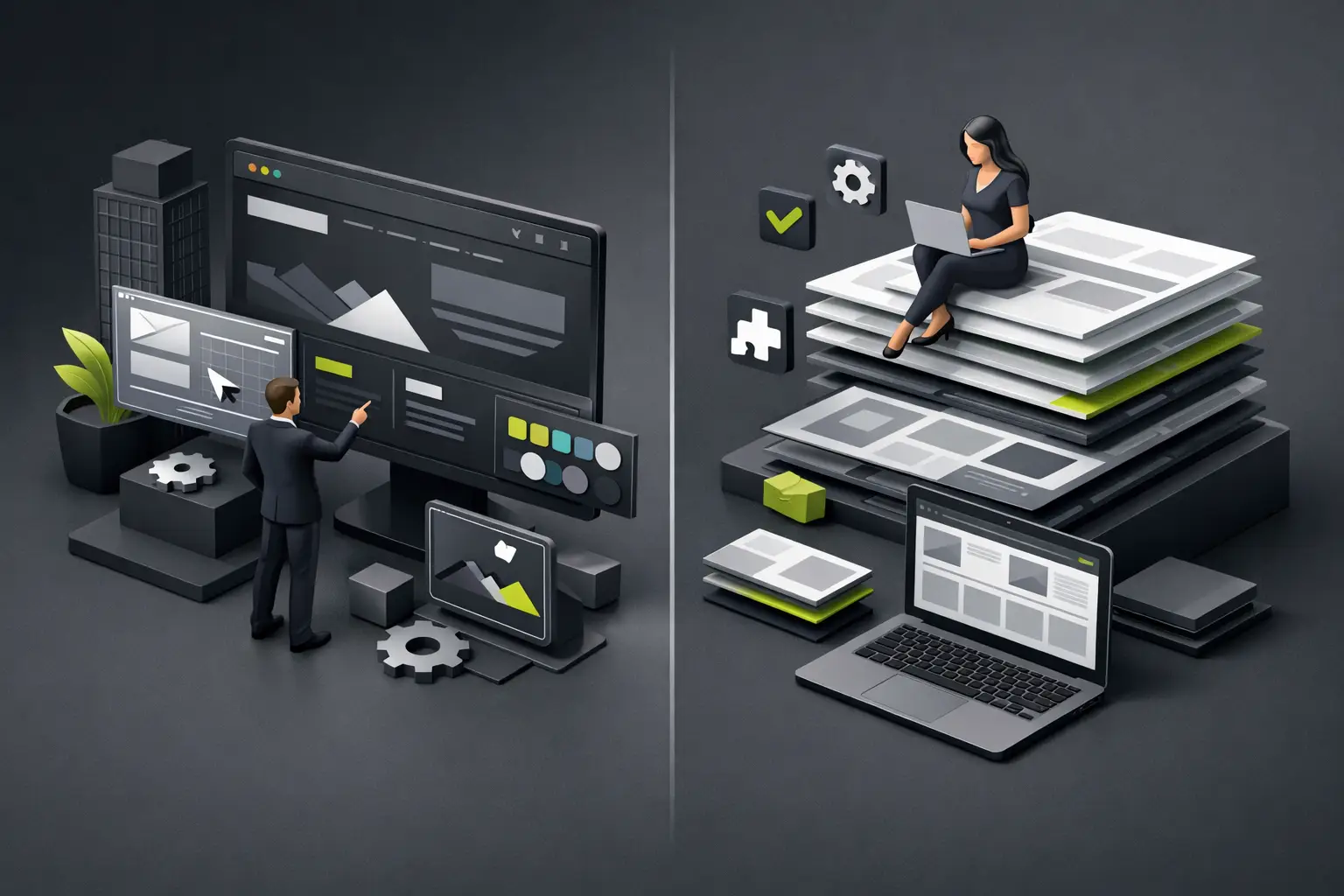
There are decisions that seem small until the site goes live and starts affecting sales, positioning and brand perception. That's what happens with the debate of custom corporate website vs template. On paper, both options "work". In practice, one can drive growth and the other can leave you fighting limitations from the first campaign.
If your company needs more than a digital business card, this comparison isn't just about design. It's about control, real speed, ability to scale, SEO and conversions. Because a corporate website shouldn't exist just to look good. It should work.
Custom corporate website vs template: the real difference
A template is a pre-designed structure. It already comes with layout, styles, components and, often, logic designed for a pretty generic type of business. This allows you to launch faster and, in some cases, spend less upfront.
A custom site is built around your brand, business objectives and audience behavior. It doesn't start from a foreign mold, but from your own strategy. That changes everything: how the user navigates, how services are presented, how content is organized and how conversion points are designed.
The real difference isn't just visual. It's how much your web can grow without starting to get in your way.
When a template actually makes sense
There's no need to demonize templates. They have a clear place. If a company is barely validating an idea, needs minimal presence or needs to publish something very simple in little time, a good template can be enough.
They also work when content is very basic and there's no high expectation for differentiation. For example, a temporary page for an event or a website with few sections and no major business integration.
The problem appears when a template is used to solve needs that are already strategic. If your business depends on generating leads, building trust, competing in search engines or standing out in a saturated category, cheap and fast can become expensive very quickly.
Where a template starts to hold you back
In the beginning everything seems efficient. You change colors, adjust text, upload photos and you're done. But then the uncomfortable details arrive: the structure doesn't fit your offering, certain sections are unnecessary, others are missing and modifying the design without breaking something starts costing time, money or both.
Also, many templates load unnecessary elements. Extra code, duplicate styles, blocks you don't use, heavy resources. That impacts performance, and performance impacts experience and SEO.
There's also a perception issue. While the user might not say "this is a template", they do notice when a site feels generic. And in sectors where trust matters - professional services, finance, hospitality, architecture, technology - that feeling can lower conversions without you noticing immediately.
The value of a custom corporate website
A custom site doesn't mean complicating things for the sake of it. It means making decisions with intention. Each section answers a goal. Each interaction has a reason. Each page exists to move the visitor one step closer to an inquiry, a booking or a sale.
That allows designing smarter journeys. It's not the same for a company selling high-ticket consulting services as for a clinic that needs to schedule appointments, or an architecture firm that needs to build visual authority. They all need a website, yes, but not the same website.
With a personalized solution you also gain editorial flexibility. Content is organized according to how your company sells, not according to how a template marketplace thought it should be. And that makes it much easier to grow without rebuilding everything in six months.
SEO: where the decision matters more than it seems
In the topic of custom corporate website vs template, SEO is often seen as a technical extra. It's not. It's a strategic layer that depends on structure, speed, content hierarchy, indexation and semantic clarity.
A template can come "optimized", but that almost always means optimized for a general scenario. Not for your keywords, your service architecture or your business objectives. In many cases, the foundation works. In others, it forces you to adapt your strategy to the mold, when it should be the other way around.
A custom site allows you to organize content more precisely. You can build pages focused on search intent, strengthen strategic categories, improve internal linking from the architecture and care for performance from the design, not as a patch at the end.
Today there's another factor: search engines integrate artificial intelligence and reward more complete signals of quality, clarity and experience. If your site feels generic, slow or confusing, it doesn't just lose users. It also loses competitive strength.
Conversion: looking good isn't enough
Many corporate websites fail for one simple reason: they inform, but don't convert. They have correct text, beautiful photos and even a "modern" design, but don't drive clear action.
A template is rarely designed for your specific business process. Maybe it puts a form where you need a booking. Maybe it prioritizes a gallery when your business needs credentials, social proof and a better explained offer. Maybe it disperses attention right before contact.
With a custom site, the interface can align with the business. That means better positioned calls to action, more convincing narrative, sections that answer real objections and flows designed to build trust at the right moment.
It's not just premium design. It's design with commercial intent.
Launch speed: the most common objection
Here many brands assume that template means fast and custom means slow. Not always. If the process is well resolved and the technology supports it, a personalized site can go live in very competitive timeframes without sacrificing quality.
In fact, that's one of the advantages of working with modern platforms like Webflow and Framer. They allow you to create custom experiences with execution speed, good visual control, flexible CMS and a cleaner technical foundation than many traditional developments or sites built on plugins.
That's why the true calculation isn't just how long it takes to publish. It's how long it takes to have a web ready to perform. A template can launch in days and spend months not producing clear results. A well-thought-out site might take a bit longer initially and start generating value much sooner.
Costs: cheap at first, expensive later
Yes, a template usually costs less upfront. That part is real. But the cost of a website isn't measured only by launch. It's measured by maintenance, ability to adapt, performance and missed opportunities.
If you later need to redesign entire sections, fix speed problems, rebuild the architecture for SEO or reconstruct the experience because it doesn't convert, the initial savings dissolve quickly.
A custom site requires more investment, but also delivers more control and less future friction. For a company that already has defined business objectives, that differential usually justifies itself quickly.
The right question isn't which option costs less. It's which gives you better return.
Which option makes sense based on where your company is
If you're starting out, with a tight budget and an offering still in testing, a template can serve as a tactical solution. Not perfect, but enough to enter the market.
If your company already sells, invests in advertising, depends on digital reputation or competes for relevant searches, a custom site is usually the smarter decision. There your web is no longer an operational expense. It's a business asset.
And if you're worried about time, it's worth talking to a studio that knows how to combine speed with personalization. Flow™, for example, works precisely on that logic: high-performance sites, visually powerful and ready to position and convert without dragging out the project.
How to make a good decision without guessing
Before choosing, ask yourself three simple questions. The first: should your site just exist or should it generate business? The second: do you need to differentiate your brand or is "looking" like the rest enough? The third: do you want a temporary solution or a solid foundation to grow?
If your answers point to positioning, conversions, control and scalability, the template probably won't be enough for you. If what you need is to quickly validate something small, it can work for a while.
There's no universal answer. But there is a clear signal: when the web becomes part of the business engine, the generic starts to get in the way.
Choosing between template and custom development isn't a design decision. It's a business decision. And when your brand is ready to compete seriously, it shows a lot.